
Orange County Criminal Court Records
A criminal court record is the court case file, not just the arrest. In Orange County, the Clerk of Superior Court is the local court record keeper for Superior Court and District Court matters. Criminal files can include charges, warrants or orders for arrest after service, magistrate orders, indictments, court appearances, bonds, pleas, dismissals, dispositions, judgments, probation, sentencing, restitution, costs, and future court dates.
North Carolina's unified trial system shapes where criminal records appear. Superior Court generally handles felony trials and matters that move beyond District Court. District Court generally handles misdemeanors, infractions, traffic offenses, initial criminal settings, and related lower court matters. Magistrates operate within the District Court Division and can be involved in criminal process and initial appearances. A closer look at the charge list itself belongs with Orange County court charges after arrest, while this page stays focused on the full court case file.
Search Orange County Criminal Court Records
The main online route is the North Carolina eCourts Portal. Smart Search can search by defendant name, case number, citation number, attorney, business name, cross-reference number, or nickname. For criminal case information, the Judicial Branch record-access page also says public self-service terminals in any clerk's office can be searched by defendant name, case number, or victim/witness name. Paper files are viewed in the county where the case is filed.
- Search Portal Smart Search with the defendant name, case number, citation number, or other known identifier.
- Filter to Orange County when location filtering is available, then compare case numbers, filing dates, and party names.
- Open the case summary or Register of Actions and review charges, hearings, events, dispositions, and financial entries.
- Use Search Hearings when the goal is the next criminal court date, courtroom, judicial officer, or hearing type.
- Use the Clerk of Superior Court for terminal access, paper files, certified copies, or cases not fully visible online.
Portal is not the only state record source. The North Carolina Department of Adult Correction has offender information for state prisoners, probationers, and parolees, and the North Carolina SBI maintains the sex offender registry. Those systems are not Orange County criminal court files. They can cross-check a sentence, supervision status, or registry issue, but the case record and disposition remain court records.
Orange County Criminal Case Stages
A criminal record changes as the case moves. A newly filed charge may have a first appearance, bond entry, next hearing date, and no final disposition. Later entries can show motions, continuances, pleas, trial events, judgments, costs, probation, restitution, or sentence terms. The docket should be read as a timeline, not as a single final result.
Case flow: Charges Filed › First Appearance or Arraignment › Pretrial and Motions › Plea or Trial › Disposition › Sentencing
| Stage | What Happens |
|---|---|
| Charges filed | Law enforcement, magistrate process, prosecutor filing, indictment, or other charging event creates court activity. |
| First appearance or arraignment | The court addresses the charge, counsel, bond, custody status, and next court setting when required. |
| Pretrial and motions | The docket may show continuances, discovery-related events, suppression motions, bond review, or other hearings. |
| Plea or trial | The record may show a plea, trial setting, verdict, dismissal, or other disposition path. |
| Disposition and sentencing | The final outcome may include guilt, dismissal, responsible finding, sentence, probation, restitution, costs, or other judgment terms. |
The manifest image from the North Carolina expunction topic shows the official court route for records that may later be removed from public access.
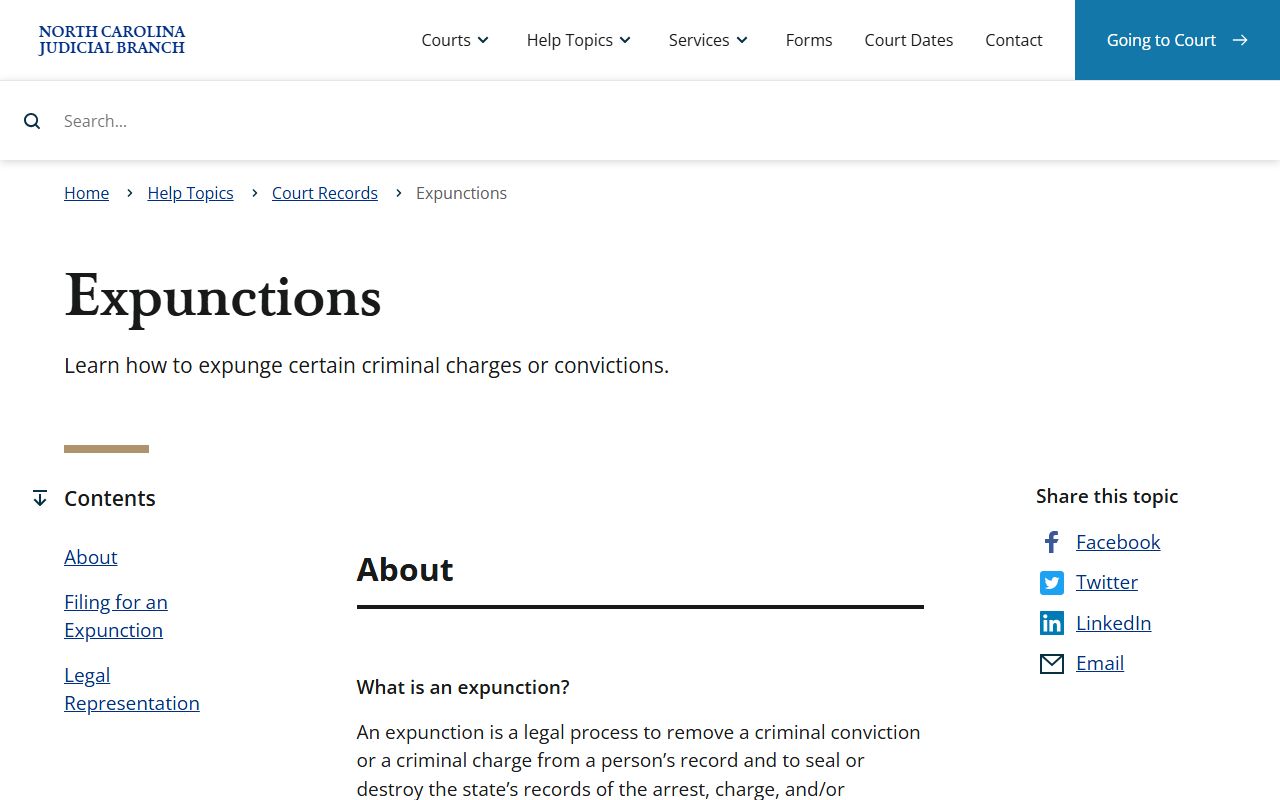
Expunction affects the public visibility of eligible criminal court records, so a missing public record may reflect a legal restriction rather than a search error.
What Orange County Criminal Records Show
Criminal case summaries and paper files can contain several layers of information. The Portal training material says a public case summary may include case information, assignment information, party information, events, dispositions, hearings, and financial information. Orange County custody-report examples show criminal docket numbers, charge descriptions, bond amounts, attorney names, court dates, agency labels, and judicial status values, but the custody report is not the full court case file.
| Field | What It Shows |
|---|---|
| Case number | North Carolina case format or criminal docket number tied to the court file. |
| Defendant | The person charged, plus attorneys or participants when public. |
| Charges | Offense descriptions, charge level, charging document, amendments, dismissals, or added counts when entered. |
| Bond | Secured, unsecured, no bond, included bond, or bond change information when shown. |
| Hearings | Date, time, courtroom, judicial officer, and hearing type when public. |
| Plea | The defendant's formal response or plea event if entered in the public record. |
| Disposition | Outcome such as guilty, dismissed, not guilty, responsible, disposed, or other case result. |
| Sentence | Punishment, probation, restitution, court costs, or other judgment terms when public. |
Charges vs Convictions
A charge is an accusation in a court case. A conviction is a final outcome based on a guilty plea, verdict, or judgment. Orange County criminal court records may show charges that were amended, reduced, dismissed, or resolved in a way that did not become a conviction. The distinction matters for reading a court record, because a charge list can be longer than the final disposition list.
| Charge | Conviction | |
|---|---|---|
| Record stage | Appears when an offense is alleged or filed in court | Appears after plea, verdict, or judgment |
| Meaning | An accusation that still may change | A final finding or admitted offense |
| Status changes | May be pending, amended, reduced, dismissed, or dropped | May carry sentence, probation, costs, restitution, or supervision terms |
| Search caution | Do not treat every charge as guilt | Read the exact disposition and sentence fields |
Orange County Criminal Case Offices
The District Attorney for Prosecutorial District 18 prosecutes state criminal cases for Orange and Chatham counties. The research identifies Jeff Nieman as District Attorney, with the district office at 144 East Margaret Lane in Hillsborough and phone 919-644-4600. The Pretrial Services research states that the District Attorney is represented at first appearances for detained defendants.
The Orange County Public Defender is part of Defender District 18 for Orange and Chatham. NC Indigent Defense Services identifies Public Defender Woodrena Baker-Harrell. The Orange County office is listed at 115 East King Street in Hillsborough with phone 919-643-4400. Public Defender representation is for eligible appointed criminal cases, not general legal advice for every records search.
| Office | Role in Criminal Records | Orange County Contact |
|---|---|---|
| District Attorney | Prosecutes state charges and appears in first appearance context | 144 E Margaret Lane, 919-644-4600 |
| Public Defender | Represents eligible appointed defendants | 115 E King Street, 919-643-4400 |
| Clerk of Superior Court | Keeps the court case file, docket, and copy route | 106 E Margaret Lane, 919-644-4500 |
Sealed vs Expunged Criminal Records
Restricted criminal records require careful reading. A sealed record is hidden from ordinary public inspection by law or court order. An expunged record is removed from public access after a statutory process and court order. North Carolina's expunction topic explains that eligibility depends on the statute, the type of charge or conviction, waiting periods, and exclusions. A person must use the correct AOC petition for the record category.
| Sealed | Expunged | |
|---|---|---|
| Public view | Hidden from ordinary public inspection | Removed from ordinary public access after order |
| How it happens | By statute or court order | By statutory petition and court order |
| Orange County filing | Handled through the court file when authorized | Filed in the county of the original case when eligible |
| Search result | May be absent, limited, or require authority | Should not appear as an ordinary public record |
The manifest image from the North Carolina Department of Adult Correction public records page helps distinguish correction records from court records.
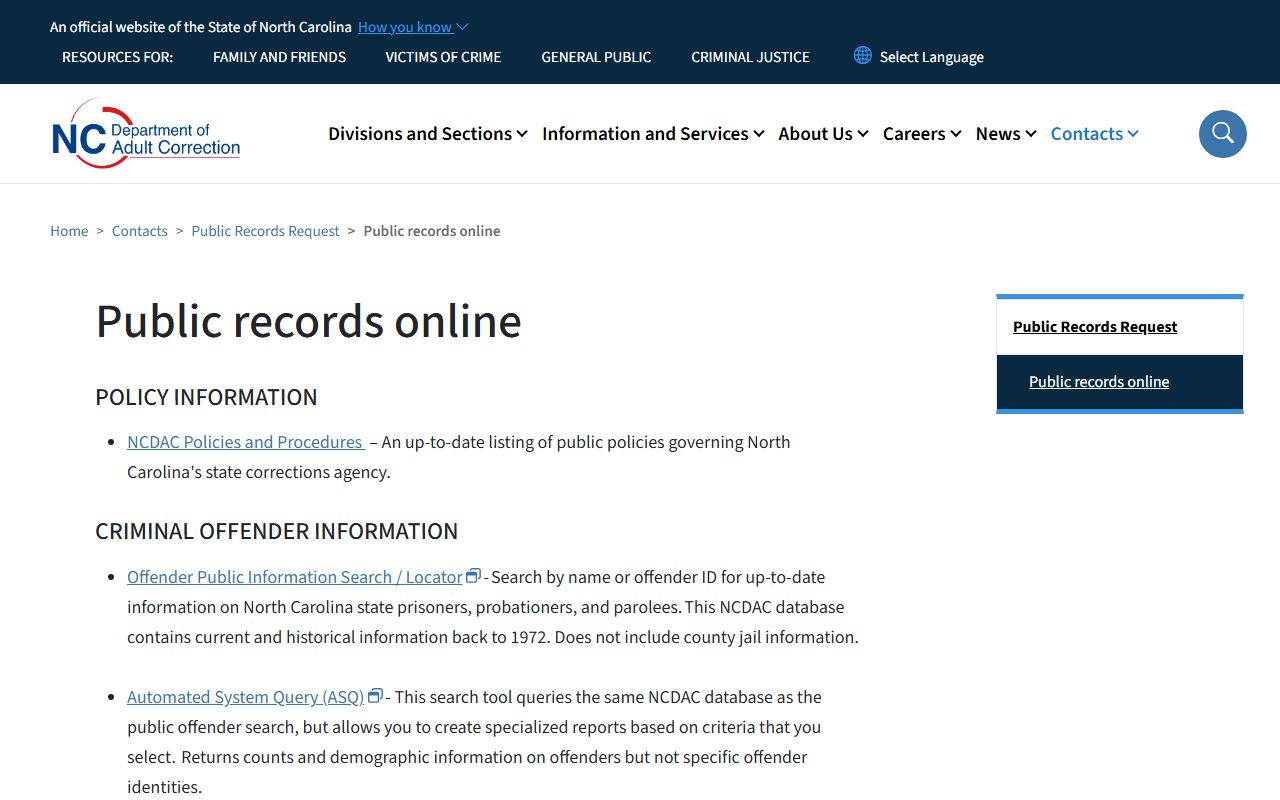
DAC can be useful for offender status, but the agency is not the custodian of the Orange County criminal court case file.
Public Access to Orange Criminal Records
North Carolina law gives the public access to many court records while preserving statutory limits. N.C.G.S. 7A-109 requires clerks to maintain court records, dockets, files, and indexes and makes them open to public inspection except where law prohibits access. Chapter 7B Article 30 governs juvenile-record confidentiality, and N.C.G.S. 15A-145.5 addresses expunction of certain nonviolent misdemeanors and felonies.
Note: Public criminal court access does not include juvenile files, sealed records, expunged matters, or confidential personal identifiers.
Restricted Orange County Criminal Records
Juvenile records are generally confidential and handled through separate written or authorized access processes. Sealed and expunged records are withheld from ordinary public lookup. Mental health records, involuntary hospitalization details, protected addresses, Social Security numbers, financial account numbers, minor identifiers, and medical details can be redacted or withheld. Some law enforcement investigative records are separate from the court file and may not be open through the clerk.
The manifest image from the North Carolina SBI sex offender registry reflects a separate public safety system, not the complete criminal case record.
Registry information can relate to a conviction, but the court file should be checked for the exact charge, plea, disposition, and sentence.